Showing posts with label winter. Show all posts

Saturday, 20 November 2021

Full Circle Garlic

One of my gardening ambitions is to become self sufficient in as many areas of growing as I can, closing the loop to reduce the amount of inputs my garden needs. This year I grew peas and many different flowers from my own saved seed, and this week I have added garlic to the list. I bought in my garlic last Autumn and after a very good crop, I have replanted my own cloves for next year's harvest. I hope this marks the end of buying in seed garlic.


Here is a photo diary of my garlic crop to show you the entire journey over one year.


October 2020 I purchased seed garlic for planting.


And plant it I did. About 50+ cloves, across a few different beds.


I covered the cloves with soil, straw and seaweed.


And up it came.


Throughout the season, I gradually added compost and seaweed for nutrients but also as mulch as the bulbs can begin to push up through the soil.


Then I started harvesting it from the end of June to August.


And drying it.


November 2021 and I still have lots of perfectly preserved dry garlic in the garage and I have replanted some of it for next year's harvest.


And that's one main crop set in motion for next year.  Autumn and winter are my favourite gardening months which makes garlic one of my top choice vegetables for growing at home. You can plant garlic NOW so get going if it's something you'd like to do.


Monday, 6 January 2020

Beach Stones for Vegetable Bed Edging

Today was a day I was looking forward to, and dreading at the same time. It was the first day back to school after the Christmas holidays, a break which has the magical ability to absolutely destroy any sense of routine. We haven't been poking our toes out of bed until 9am at the earliest for the last two weeks. We woke to torrential rain and strong wind, which wasn't a great welcome, but by 11am it had cleared to an absolutely fabulous clear skied and sunny day. So I enticed a lazy three year old off the couch with a trip to the beach to play with his diggers on the sand while I foraged some big stones to use as edging for my burgeoning vegetable beds. I have already salvaged any sizable piece of stone from around the garden for the same purpose. As I happened to have a bin bag in the boot of the car, I also decided to scoop up a load of washed up seaweed.

My beds are looking pretty this evening after a bit of work. One is completed and the other needs another load of stones:


Saturday, 23 November 2019

Using Seaweed in the Garden


Early Winter is a great time to put fresh seaweed on your empty beds. I just gather the wet seaweed that washes up on the beach (not the stuff still growing attached to rocks) and lay it out on the beds and let the rain wash it clean. By Spring it will have decomposed into the bed. It can get a bit glutinous and unappealing during this process but unless you are hoping to have quality time hanging out beside it, it's nothing that will bother you. You could also cover with soil.

The above photo is a bag of seaweed I collected on my local beach last week. I tried to avoid the large stems that are often attached as they are slower to break down, although as I am typing I am recalling someone telling me that the stem is the most nutritious part.... not sure if that is a real memory. Seaweed definitely improves the soil. My main vegetable patch in my old house produced its best crops in the season directly after my first application of seaweed. The effect was unmistakable.

And thanks to my penchant for taking photos of the garden constantly, I have before and after photos. The first photo was taken in November and the second photo was taken in the following July:


Not only does applying seaweed cover the bare soil reducing leaching of existing organic matter, it keeps the soil moist and adds nutrients including nitrogen, potassium, phosphate and magnesium. It also contains elements that plants need in small amounts like iron, manganese, copper, boron and zinc, which can be lacking in other fertilisers. It doesn't contain any weed seeds either. You can safely apply fresh seaweed directly as a mulch to your growing crops as well as digging it in to the soil. Opinions vary as to whether you should rinse it first or not. Some people think the salt will deter slugs, others say it might damage certain plants.


This is my new garden where I am just beginning my vegetable patch. I made a few beds last year which produced some beautiful vegetables but I've decided that they are too close to the septic tank for comfort. I'm worried about contamination in the soil from the soakaway. The following photo is the other side of the garden. All I've done here so far is cover three areas with large pieces of carpet to kill off the undergrowth. The carpet has been down two months. One bed has been covered with seaweed this week, and two more to go. For the other two beds I am going to shovel a load of compost from my garden heap on to the bare soil and then cover with seaweed. I am significantly excited writing this. Better get my wellies out tomorrow.


Tuesday, 29 December 2015

My Garden: 24th December 2015

Happy Christmas all. I haven't posted in ages because anytime I get a chance to take photos, night has already fallen. At least we have gotten through the shortest day of the year and are looking towards the light.  The weather has been dismally wet for weeks now. A lawn enthusiast would cry to see me walking over the boggy grass. Although it appears our drainage is pretty good; the grass is soggy but not holding puddles of water.
 
 
Despite the unfriendly conditions, I get a warm feeling when I look at the vegetables growing in my garden. I have garlic, onions, purple sprouting broccoli, broad beans and lambs lettuce. I've said it before (to myself perhaps) that Autumn/Winter is possibly my favourite time of year for gardening. Options are limited which means you are more likely to do things properly. Growth is slower so problems are smaller and pests are reduced.
 
 
In this bed I have Early Purple Wight garlic:


And under cover in modules I have Solent Wight and Lautrec Wight garlic, which will be planted out in Spring:


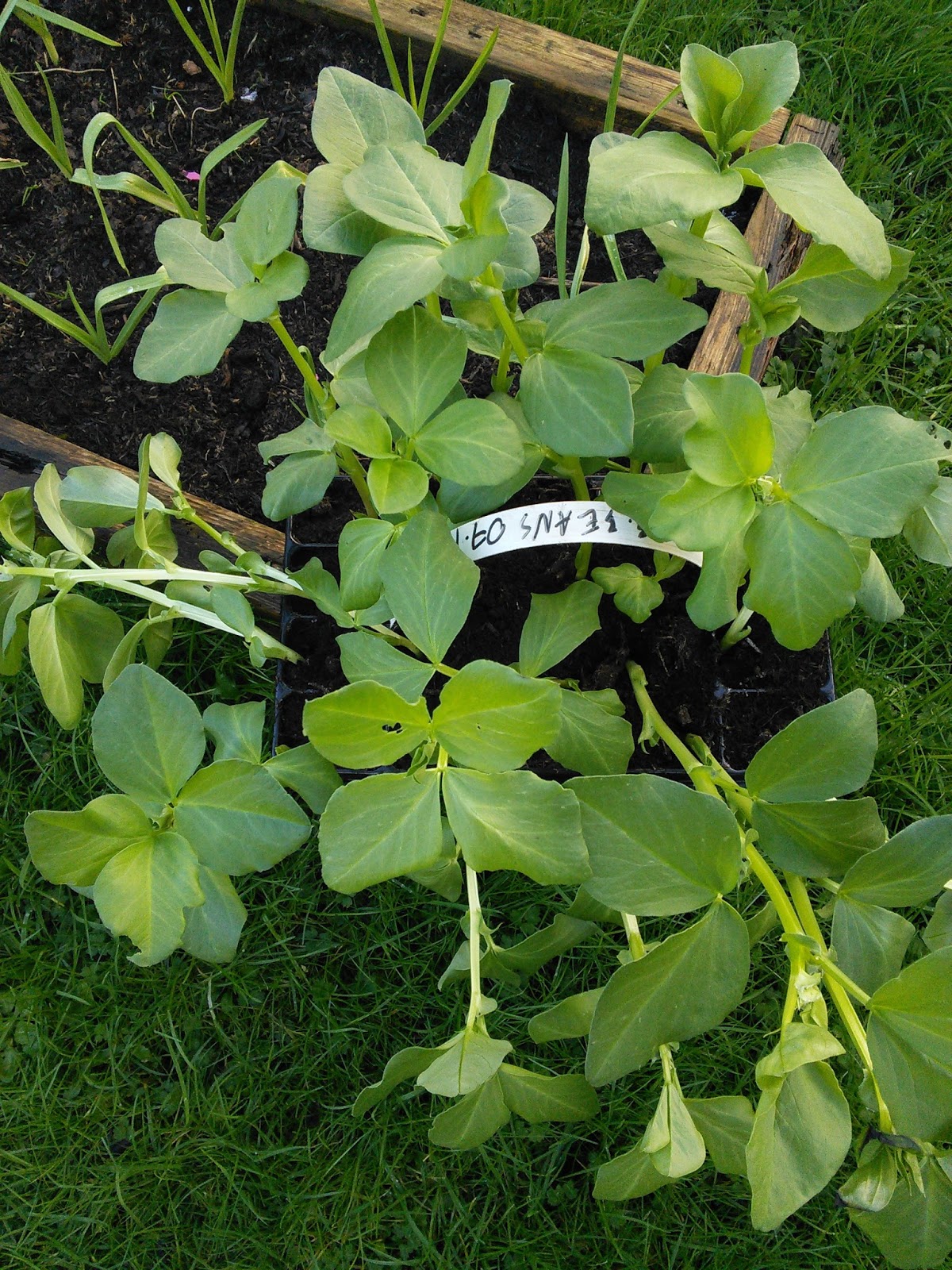
I have broad beans in modules which are being kept under cover. The mild temperatures have led to more growth than expected so I wonder if I should move them to bigger pots. For the meantime, they are looking nice and healthy so I'll leave them be:


Other broad beans are in the ground, framing the new bed I dug in the Autumn. The last of the seaweed mulch is being turned to soil:


I have many purple sprouting broccoli plants but only one producing food yet. This plant is from last year and is miles ahead of the others. It's my first time treating a vegetable as a biannual and I am delighted to get a second harvest:


Wallflowers are showing a splash of colour and you'd be forgiven for thinking the purple flowers belong to the broccoli plant in front of them:


Some lambs lettuce takes shelter in the corner of a window box. I like to call this my "snack box":


Senshyu onions in their bed. They look a little crowded but hopefully as I pick the small onions, room will be given to allow others to swell:


That's all the highlights from the garden. Till next year...

Thursday, 19 February 2015

Thoughts on the Winter Garden

I have to share a wonderful quote I heard today that expresses perfectly how a gardener feels during the long winter season:


From December to March, there are for many of us three gardens - the garden outdoors, the garden of pots and bowls in the house, and the garden of the mind's eye.

Katherine S. White


If only I could get real life to reflect the lavish creation of my mind's eye.

Wednesday, 11 February 2015

My Garden: 11th February 2015

It's been a while since I've posted an photo diary of my garden. The last month has been cold and uninviting and my trips to the end of the garden have been fleeting and only when necessary. Now the first flashes of spring colour are erupting and suddenly the garden is a comforting place to be, once again.


These delicate crocuses will be my first flower of the new year:


Hyacinths are another bloom I am looking forward to witnessing in full flower:


My daffodils and narcissuses have multiplied over the last few years developing into little bunches of flowers where originally only one flower stood. As you can see, I am not lawn proud although the grass has yet to be cut this year:


Now to the back garden where the good stuff stands. Even though I haven't been very productive outdoors over winter, I still have quite a bit going on from plants that are producing food for us to eat at the moment, to plants that won't be mature for another few months.


One lonely leek remains:


Back in the Autumn I covered the neighbouring onions (Senshyu sets) in a layer of seaweed that had washed up on shore after a storm:


As you can see, the seaweed has completely decomposed into the soil:


My garlic is coming up strong. I bought four seed bulbs for planting last autumn (Provence Wight, Iberian Wight, Early Purple and Solent) along with one bulb of Iberian saved from my own harvest. By planting that amount I was hoping for a harvest of one bulb per week for the following year, plus some left over for planting next season. Finally, I would be self sufficient in one crop!  I planted my own bulb and the Solent, keeping the others for later planting....and I lost the damn things. I've searched the house with no luck. I couldn't bring myself to pay for more bulbs and resigned myself to the hope that they would turn up in time for late winter planting. Well it's February now so I think that ship has sailed.


Finally after almost a year after sowing the seeds, my purple sprouting broccoli is starting to produce a beautiful colourful head:


I have eight plants, far too much for one family, but they are not all looking quite so healthy. Fat pigeons have been perching on top and dining to their hearts content. It's time to pull out the netting again:


Finally, my broad beans have been coming along under cover.  I took them out for a breath of fresh air today. I have only two plants out of about six seeds planted. I should have planted more.


Thursday, 30 January 2014

The Irish Winter Landscape

The days may seem too short but winter in Ireland bestows on us some of the clearest, sunniest, heavenly days of our climate. These are the days I choose to remember and this year I have visited some beautiful local spots.

1. Charles Fort, Kinsale


The views from inside and outside the fort are one of my favourite in the Cork county. Even if you choose not to go inside, there is plenty to enjoy if you want to just stop your car at the side of the road for a few minutes. Note the bird of prey just over the low clouds on the right hand side.


From the busy front promenade in Kinsale town, there are some peaceful water views.


2. The Owenabue River, Carrigaline


Just ten minutes walk from my house, this river has a wonderful desolate poetic bleakness on a dark winter's day.


3. Ringaskiddy


Ten minutes drive down the road brings me to Ringaskiddy, which I think is a harmonious meeting of industry and nature (aesthetically anyway, local cancer rates might say different...). Boat yards and industry adorns the shore line, which opens out into Cork Harbour. It's a great place for a walk, but watch don't you fall down one of those giant rabbit holes.


4. Killarney National Park


Whether you desire a short stroll or a day-long hike, the area covered by Killarney National Park abounds in natural beauty including sights like Torc Waterfall and the lakes (below).


For a tamer, more manicured walk, explore the gardens of Muckross House with their pretty features including the Stream Garden.


Friday, 4 October 2013

Growing Vegetables over the Winter Months


There are endless options for the gardener when planting seeds in Spring. The choice can be so overwhelming that quite often we end up buying more seeds that we can cope with, or physically grow in the space we have. It is easy to go full throttle in March and April, to find that we have a load of vegetables ripe for picking at the same time and then....nothing!

The good news is the growing season does not end with the summer and some plants grow much better in cooler weather. Last year I made a good attempt at growing over winter and these are where my success lay:


1. Salad Leaves


I personally have little success with salad leaves in summer, too much slug activity and a good chance the plant will go to seed. Last October I planted spinach and cos lettuce and kept them under cover in the greenhouse for the winter. They grew to a certain point, maybe two inches in height and stopped.


I paid them little attention, occasional watering and planted them out in March. By May, the crop was strong and abundant and got absolutely NO slug damage. I think this was due to the leaves maturing before the slugs really got active. They must have delicate taste buds! I cut and cut from the spinach and cos plants and they kept producing leaves for months. A truly successful crop.


You may notice the flowering plants in the back ground, which are broad beans. Beans, and the other legumes, have the ability to take Nitrogen from the atmosphere and fix it into the soil. Leafy veg requires high levels of Nitrogen, so they are good companion crops.

Which leads us to:


2. Broad Beans

Most gardening guides will recommend various times for the planting of broad beans. I planted them under cover last October and had so much success that I will do exactly the same this year. The reason autumn planting is recommended, is to avoid the dreaded black bean aphid infestations that early summer brings. I managed to produce a large crop of beans before the aphids came [and made easy work of my plants] and this is how I did it:

I planted the beans in window boxes and kept them in the greenhouse


By May, the tops were ready to be pinched off and steamed [delicious]


And the crop was mature for picking at the end of May


Just as the beans were ready for picking, the plants got totally covered in aphids so I dread to think what would have happened to my crop if I had delayed planting until the spring.


3. Garlic


I planted cloves from a supermarket bulb in October last year and got a small bulb from each clove which were ready for eating around the end of July. This year, I'm thinking of investing in proper seed garlic as, although I was happy with the results from the supermarket cloves, I am hoping that proper growing garlic will produce larger cloves.

4. Spring Cabbage


Cabbage is another crop that can be planted at the end of summer for spring eating.  This is my first year trying cabbage.

Seeding planted on the 10th of August [8 weeks ago]:


And some planted two weeks ago


I'll be planting them in the ground once established.


Spinach and lambs lettuce planted last week are making an appearance already. Note my lovely homemade newspaper pots as outlined here


Other vegetables I am going to sow this week include radishes and pak choi. The weather is still very mild and supposed to stay the same until the end of October so take full advantage.

Monday, 29 October 2012

Winter Vegetable Planting

As I become more involved with growing my own food, my ultimate dream is to have a garden that is producing twelve months a year. I am far from that day but as the winter closes in, preparation is key (and patience is required).

My gardening tasks this month have included the following:

Gathering fallen leaves for leaf mould, which are being stored in bin bags for at least a year,  by which time they should have transformed into usable, healthy compost. If the leaves are dry, add some water to moisten. 

Tending to my brussell sprouts, which I have ignored for the last few months. The sprouts are a little small but they'll definitely be making an appearance on my Christmas day dinner plate. Yellow leaves have been removed.


Planting winter greens such as Cos lettuce and Spinach under cover:


Planting garlic outdoors (simply shop bought cloves):


Garlic plantings I made a week ago have already made an appearance over the soil:


Broad beans have been planted and are erupting with strength:


My cherry tomato plants bore great fruit this year, but four out of five have died away. The one remaining is still lush and green so I have taken some cuttings of the side leaves and replanted in the hope of establishing some new planted ready for next Spring:


Winter is also a good time for planting herbs, once they are indoors and in a sunny spot. I have basil established and have purchased coriander, chives and dill for planting.

It's a time to dig your garden to break up the soil and add compost.

You can move and plant fruit trees during this dormant season.

Although the seed packet doesn't confirm this, I have read that chinese leaves like Pak Choi can be planted successfully at this time of year, so I have planted some in window boxes in the greenhouse so hopefully they might be ready for Christmas too.

And to finish off, here are some of my "wild" flowers still blooming, with some preparing to open: